More Than a Job: 20 Regencies, 10 Years, and a Lifetime of Lessons

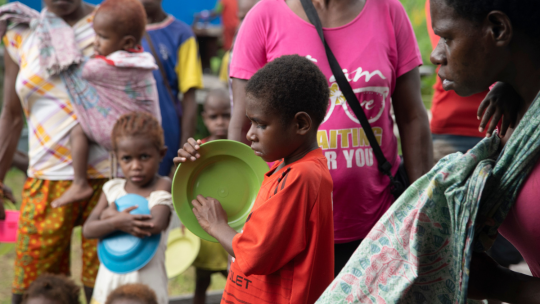
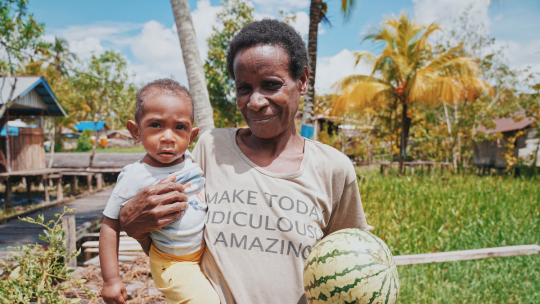
One of the perks of being a humanitarian worker is the opportunity to go on business trips across Indonesia. Moreover, travelling to the most remote and beautiful villages serves as a journey that fosters humility and enriches one’s perspective. Being present in the lives of the most vulnerable children is a truly special moment. In every journey, care and commitment to striving for children's well-being flourish.
In his ten years as a humanitarian worker, Eduard Christian (33) has visited more than 20 regencies in Indonesia. Visits to Wahana Visi Indonesia (WVI) assisted areas—stretching from Nias in the west to Merauke in the east—always hold unique stories for the man affectionately known as Edu. However, he learned and grew the most while serving as a monitoring and evaluation coordinator in South Nias towards the end of 2015.
"Whenever I met children, one of the questions I often ask is, 'What do you want to be when you grow up? What is your dream?'. To many, this question might seem trivial, very simple, or just a bit of small talk. However, I’ve realised that this question is incredibly impactful and meaningful for children in the most remote areas," Edu remarked.
When a child who has rarely received attention is asked, "What is your dream?", the question signifies a deeper level of care. Behind innocent answers like "I want to be a doctor!" or "A teacher," children are actually igniting a spirit to strive harder and surpass the barriers they face. This question sparks the courage to dream.
"At that time, there was one child who boldly answered, 'I want to be an astronaut,'. This was certainly unusual for most children there. Most would answer with professions they see every day. But from that child's answer, I realised that the most important things children need are inspiration, role models, and exposure to new things that have the power to change their lives," he explained.
Supporting children in South Nias also taught Edu about commitment, especially when things were not going well. "One moment in 2016 became my lowest point while working at WVI. I was entrusted with managing a tuberculosis eradication programme, but a young girl was not treated correctly and passed away too soon," he shared. He felt he had failed to manage the programme effectively. "At that time, I felt like resigning from WVI."
That moment became a pivotal turning point in Edu's life. He realised that the phrase "Do your best and God will do the rest" truly needs to be practised in humanitarian work. The subject of this work is humanity itself, with diverse backgrounds and various arbitrary determining factors, meaning many things are beyond one's control.
"No matter how good the planning, how smart the person, or how great our team is, when we are involved in humanitarian work, God is the ultimate controller. After that incident, I have always tried to make time to communicate with God, no matter how busy my schedule is. We need to depend on Him more, be humble, and certainly be mindful of God’s perfect providence," said the graduate of Parahyangan Catholic University.
The children and Indonesian communities Edu has met are the best teachers who have taught him many of life's values. WVI has become his classroom. For the past ten years, Edu has learned how to be a person who is always grateful, stays grounded, is fully present for the most vulnerable children and communities, and continues to share what he has—which is not always material.
"Helping others can never stop because situations keep changing and the issues surrounding poverty will always exist as part of how the world works. So, in my opinion, helping others cannot be measured by the type of job, financial capability, or specific expertise alone. Anyone, anytime, and in any way can help, as long as they are willing—and this cannot be limited by time," he asserted.
Despite the many lessons Edu has learned and the issues of child vulnerability he has witnessed, he has not become pessimistic. On the contrary, he finds so much potential that must not be overlooked. Currently, in his role as Operations Management Lead at WVI's national office, Edu remains optimistic about the future of Indonesian children.
"I am very confident that Indonesia does not lack good people with the heart to continue realising a full life for children. The key is to be brave enough to be the solution and willing to contribute without waiting for others to act first. Indonesia will not lack great children. We, as adults, have the answers to build a better environment—the question is whether we are brave enough or not," he stated firmly.
Reflecting on what Edu has shared, it is time for us to start filling our life's timeline with journeys that help others, especially children in the remote villages of Indonesia. In every journey we take, and in every person we meet, let us not forget to be present and to care. In every task God entrusts to us, let us continue to work from the heart and leave room for God to take the lead.
Author: Mariana Kurniawati (Communication Executive)